
Start here · Format & Workflow
Screenplay Template
What a clean screenplay template should take care of for you, and what still has to come from the writing.
01 / The idea
What should a screenplay template include?
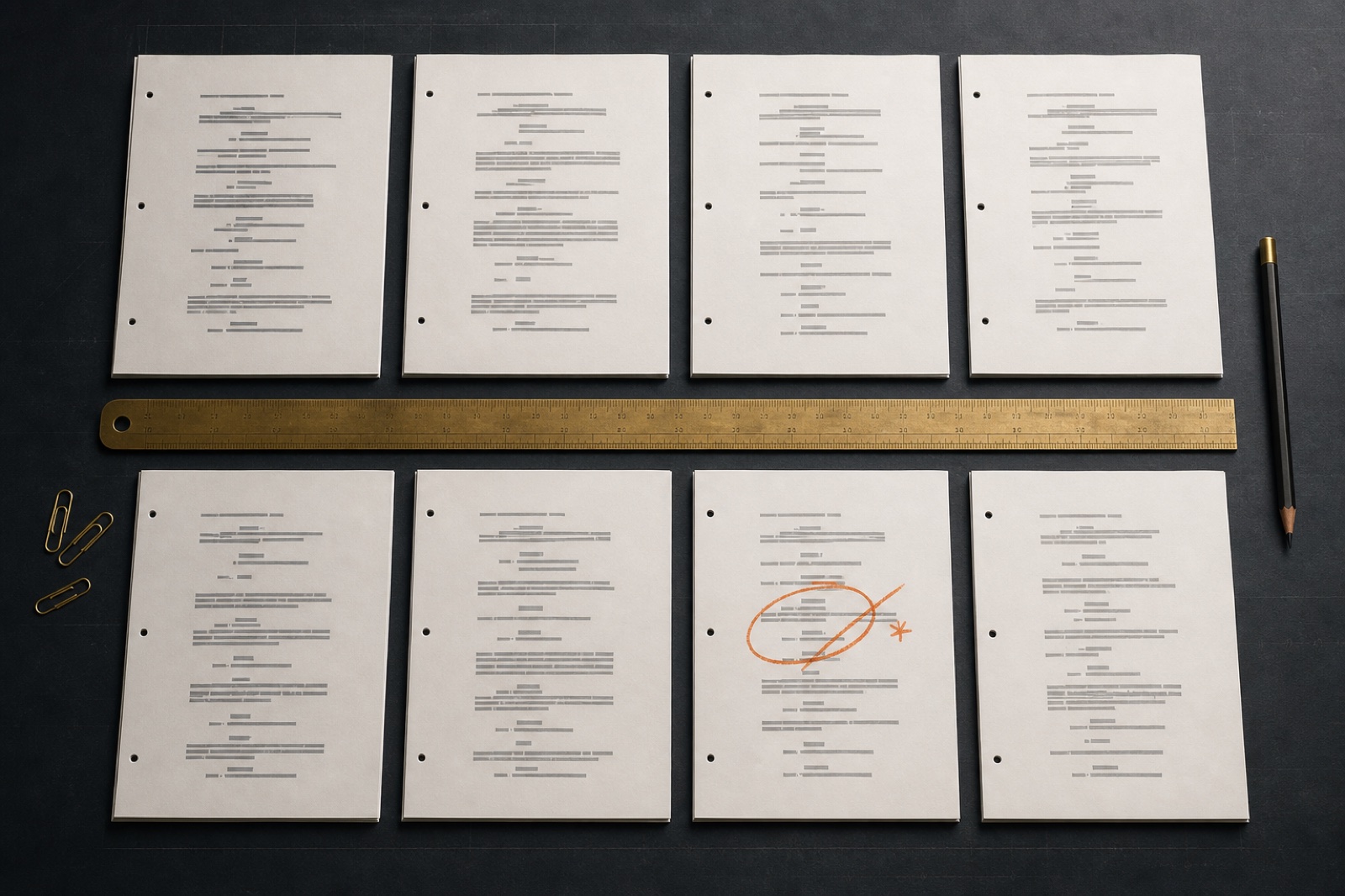
A reliable template includes title-page basics and correctly styled scene headings, action, character cues, dialogue, parentheticals and transitions. Its job is to disappear while you write.
Formatting is meant to help the reader forget they are reading. Once the basics are right, the page gets out of the way and the film can start playing in their head.
02 / What to remember
Three things worth holding onto
None of this is about looking clever or perfectly ‘industry’. It's about being considerate to the next person who opens the PDF and giving your story the cleanest possible read.
Defaults should be boring
Professional format is valuable because readers do not have to decode it. Save visual invention for the story.
Templates do not solve pagination
A page count emerges from writing and formatting together; forcing prose into a target creates unnatural density.
Production drafts are different
Scene numbers, revision colours and locked pages belong to production workflows, not most speculative submissions.
03 / On the page
Try it this way
Set things up once, keep the process simple and save your attention for the writing. The best workflow is usually the one you can still trust at eleven o'clock the night before a deadline.
- 1
Choose the right format
Start with a feature, one-hour television or half-hour template appropriate to the project.
- 2
Complete a restrained title page
Include title, written-by credit and contact or representation details when required.
- 3
Test special elements
Learn how the template handles dual dialogue, phone calls, intercuts and continued scenes before the deadline.
- 4
Remove hidden residue
Before sharing, check comments, watermarks, draft labels and incorrect metadata.
04 / Trouble spots
If this feels familiar, take another look
The template came from an unknown word-processing file.
Decorative fonts appear on the title page.
Scene numbers are included in a spec script without reason.
Manual spaces break when the file is exported.
Don't treat this list as a scorecard. Every draft has a few of these. Pick the one causing the most trouble, find the earliest place it appears and work forward from there.
05 / Have a go
Try this on your script
Create a reusable blank project, then export a two-page test PDF. Keep it as your clean starting point rather than duplicating an old screenplay full of hidden styles.
A couple of questions writers ask
What should a screenplay template include?
A reliable template includes title-page basics and correctly styled scene headings, action, character cues, dialogue, parentheticals and transitions. Its job is to disappear while you write.
How can I practise screenplay template?
Create a reusable blank project, then export a two-page test PDF. Keep it as your clean starting point rather than duplicating an old screenplay full of hidden styles.
Where to go next