
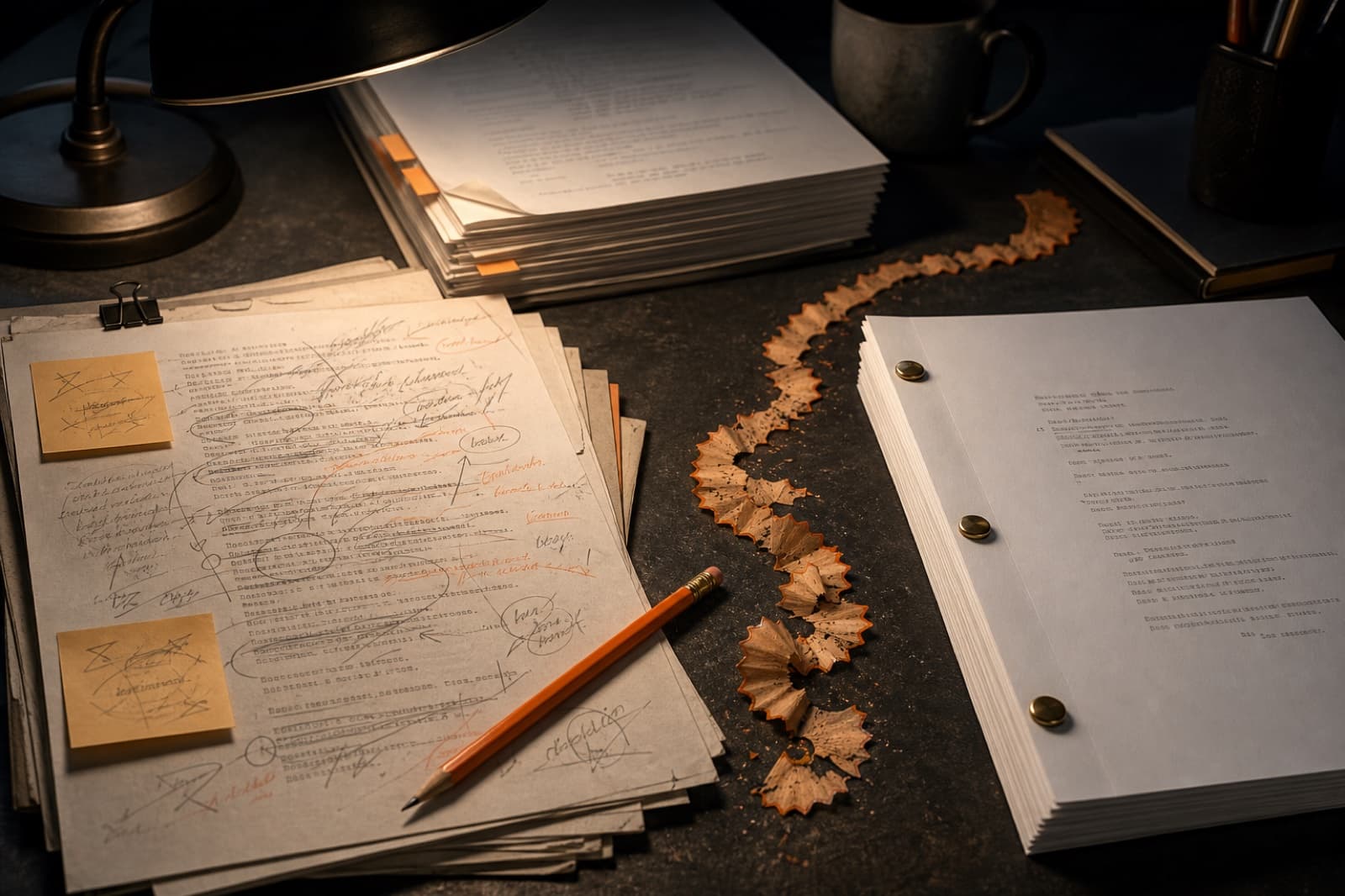
Core craft · Revision & Feedback
Rewriting a Screenplay
How to face a rough draft without despair, work from the big problems downward and protect what is already alive.
01 / The idea
Where should a screenplay rewrite begin?
Start with the big things: what the film promises, whose story it is and whether one event really leads to the next. Polishing lovely lines won't rescue a lead character who has nothing to do or an ending that belongs to a different film.
Rewriting can make a good writer feel briefly hopeless. That's normal. The draft has stopped being the exciting film in your head and become a stack of very specific problems—but specific problems can be solved.
02 / What to remember
Three things worth holding onto
Be firm with the pages and kind to yourself. The point isn't to prove the draft was bad. It's to notice what the story is trying to become and help it get there.
Work out what hurts before reaching for a fix
Start with what the reader actually felt—confusion, repetition, distance, predictability—before deciding what page event must change.
Rewrite from large to small
Premise, structure and character choices affect scenes; scenes affect dialogue; dialogue polish cannot work upstream.
Protect the living parts
A rewrite is not improvement by uniformity. Identify the scenes, images and relationships that contain the project's distinctive life.
03 / On the page
Try it this way
Take one pass at a time. If you try to repair structure, character, dialogue and commas in the same afternoon, you will mostly exhaust yourself.
- 1
Take distance
After finishing, wait long enough to read what is present rather than what you remember intending.
- 2
Write yourself a short, honest rewrite note
Choose three priorities, the evidence for each and what success would feel like to a reader.
- 3
Work in passes
Check how one event leads to the next before a character pass, then scene pressure, dialogue and proofing.
- 4
Compare outcomes
After revision, reread the whole script and check whether fixes created new continuity or pacing problems.
04 / Trouble spots
If this feels familiar, take another look
Every note is attempted at once.
The opening is repeatedly polished while the ending changes.
Symptoms are cut without repairing their cause.
The writer removes all unusual choices to make the script safe.
Don't treat this list as a scorecard. Every draft has a few of these. Pick the one causing the most trouble, find the earliest place it appears and work forward from there.
05 / Have a go
Try this on your script
Write a one-page letter to yourself from the draft: what it is trying to be, where it loses that identity and the three changes that would most restore it.
A couple of questions writers ask
Where should a screenplay rewrite begin?
Start with the big things: what the film promises, whose story it is and whether one event really leads to the next. Polishing lovely lines won't rescue a lead character who has nothing to do or an ending that belongs to a different film.
How can I practise rewriting a screenplay?
Write a one-page letter to yourself from the draft: what it is trying to be, where it loses that identity and the three changes that would most restore it.
Put the lesson into practice
Screenplay Rewrite Action Plan
Turn screenplay feedback into an ordered rewrite plan that prioritises the biggest causes, protects strengths and gives the next draft a clear sequence.
See what the report includesWhere to go next