
Deep dive · Structure & Plot
Writing a Powerful Midpoint
What can happen halfway through a film to make the second half feel new, riskier and emotionally deeper.
01 / The idea
Why does the midpoint matter?
The midpoint prevents the second act from becoming one long incline. It reinterprets the pursuit: a false victory reveals a deeper threat, a defeat creates new knowledge, intimacy raises the cost or the protagonist shifts from reacting to acting.
Structure can sound like engineering homework. On the page, it's much more human: somebody tries something, it changes the situation, and now they have to deal with what they started.
02 / What to remember
Three things worth holding onto
Think of these as questions to ask when the middle sags or the ending feels borrowed. They are there to help you hear the story, not force it into a template.
Change the meaning
A useful midpoint makes earlier events look different or changes what success now requires.
Move from experiment to consequence
Before the centre, the protagonist can test the new world. After it, choices should carry sharper and less reversible cost.
Join inner and outer pressure
The best centrepieces affect both the practical plot and the protagonist's way they protect themselves.
03 / On the page
Try it this way
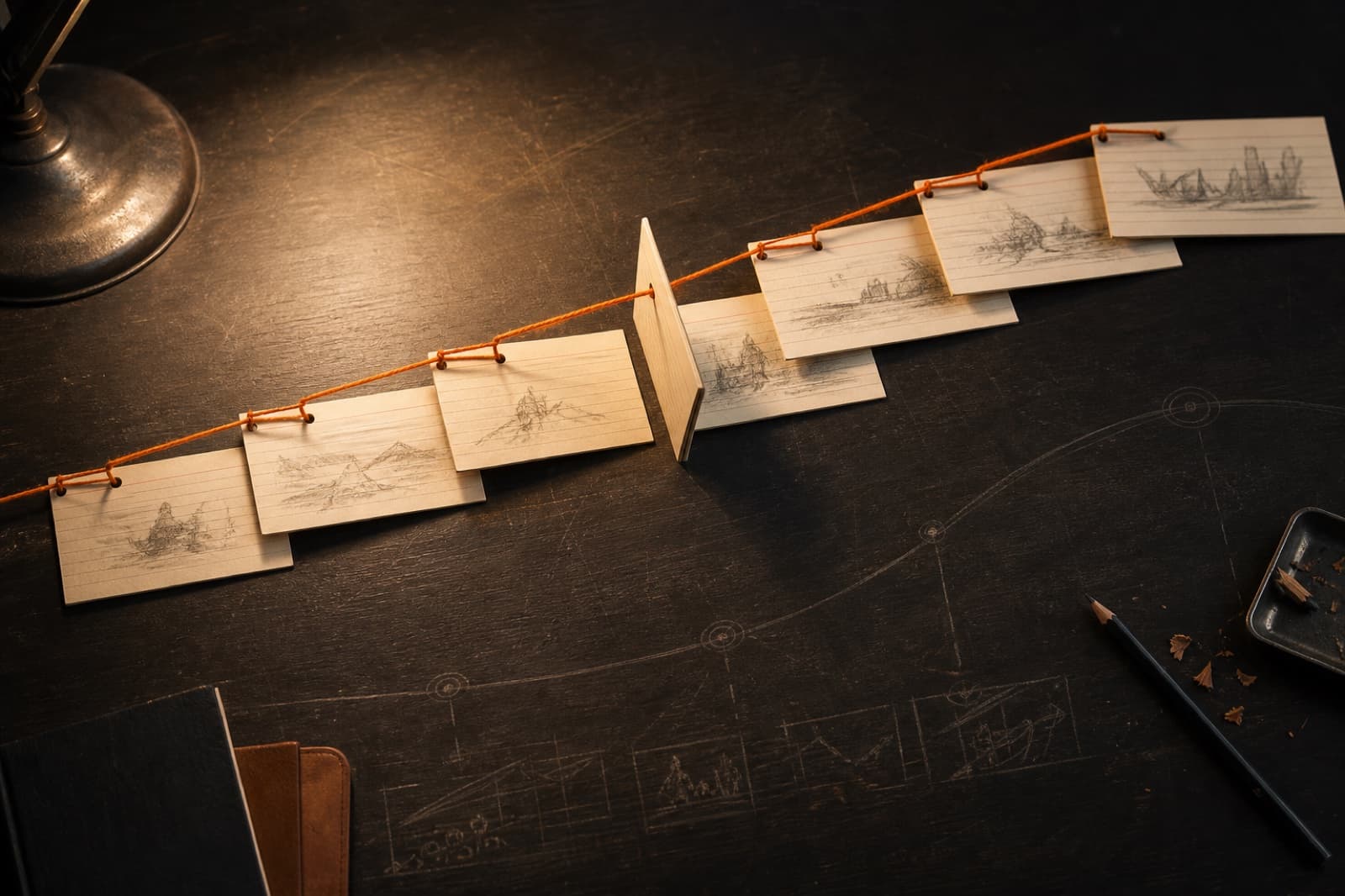
Try this with index cards, a notebook or the margin of your draft. The tool does not matter. What matters is seeing how one choice leads to the next.
- 1
Audit the first half
Identify what the protagonist believes about the problem when they enter act two.
- 2
Choose the revelation
Decide what truth, victory, loss or commitment makes that belief insufficient.
- 3
Alter behaviour
Show the new understanding through a changed tactic in the next scene.
- 4
Echo at the climax
Let the central turn plant the insight or wound that the final choice will complete.
04 / Trouble spots
If this feels familiar, take another look
The midpoint is only an action set piece.
The story returns to the previous strategy immediately afterward.
New information has no emotional cost.
The central turn could be moved twenty pages without effect.
Don't treat this list as a scorecard. Every draft has a few of these. Pick the one causing the most trouble, find the earliest place it appears and work forward from there.
05 / Have a go
Try this on your script
Write a before-and-after list: what the protagonist knows, wants, risks and is willing to do on either side of the midpoint. At least two categories should change.
A couple of questions writers ask
Why does the midpoint matter?
The midpoint prevents the second act from becoming one long incline. It reinterprets the pursuit: a false victory reveals a deeper threat, a defeat creates new knowledge, intimacy raises the cost or the protagonist shifts from reacting to acting.
How can I practise writing a powerful midpoint?
Write a before-and-after list: what the protagonist knows, wants, risks and is willing to do on either side of the midpoint. At least two categories should change.
Where to go next