
Core craft · Structure & Plot
Plot
How one choice leads to another, why trouble should keep changing shape and what to do when the middle feels like a list of errands.
01 / The idea
What makes plot feel inevitable rather than mechanical?
A good plot feels surprising in the moment and obvious afterwards. One choice leads to another, the result is bigger or stranger than the character expected, and before long they have helped to build the very trap they're trying to escape.
Structure can sound like engineering homework. On the page, it's much more human: somebody tries something, it changes the situation, and now they have to deal with what they started.
02 / What to remember
Three things worth holding onto
Think of these as questions to ask when the middle sags or the ending feels borrowed. They are there to help you hear the story, not force it into a template.
Let us know what they are after
The audience needs to understand what the protagonist is trying to change, even when the deeper need remains hidden.
Opposition must adapt
Static obstacles become repetitive. An effective opposing force learns, changes tactics and attacks what the protagonist values.
One thing should lead to the next
A scene belongs to the plot when it changes what people know, which options remain, how relationships stand or what it will cost.
03 / On the page
Try it this way
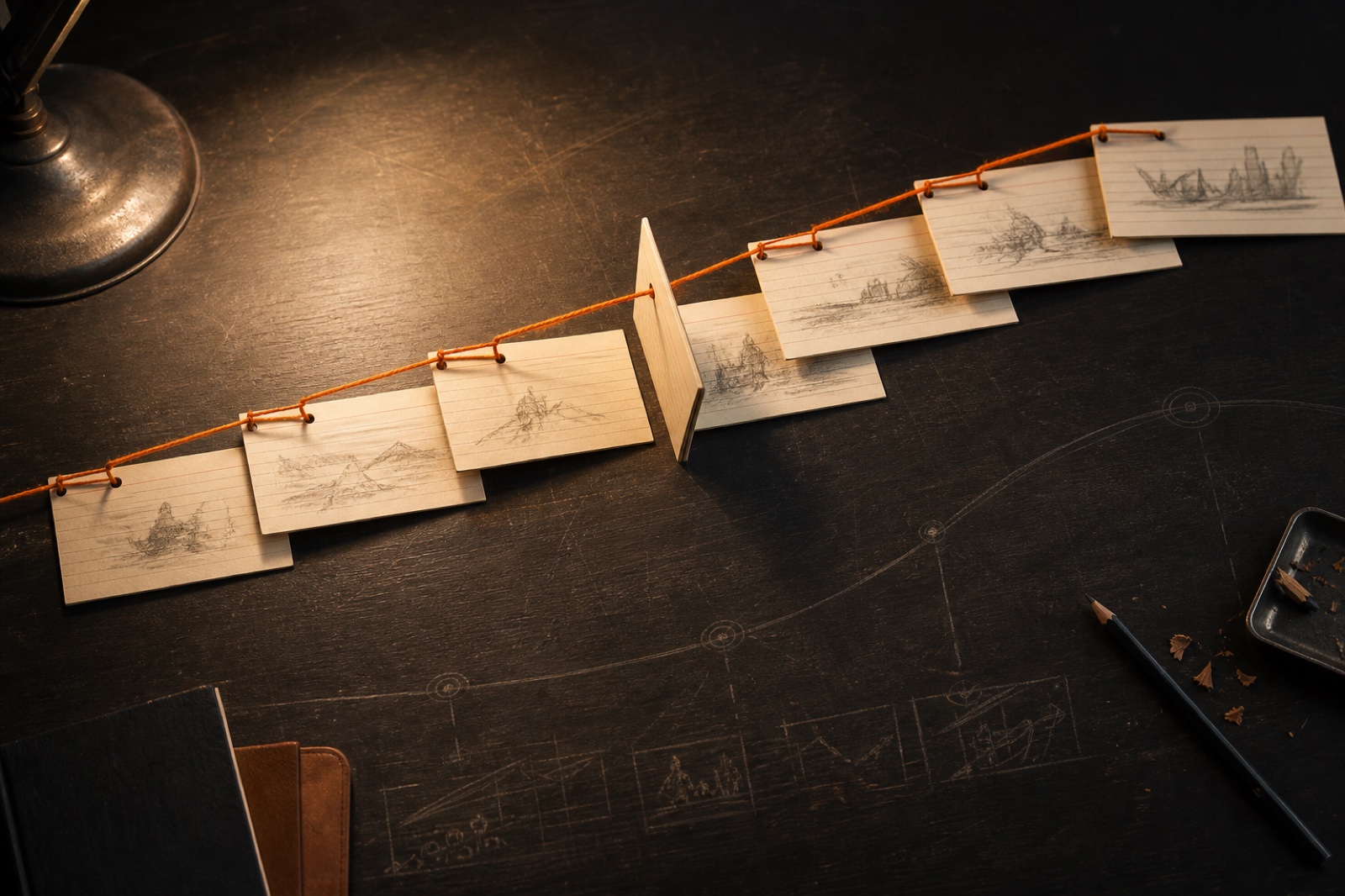
Try this with index cards, a notebook or the margin of your draft. The tool does not matter. What matters is seeing how one choice leads to the next.
- 1
Say what they are trying to do
Turn the central desire into a goal we can actually see them working towards, with a finish line we understand.
- 2
Build the opposing strategy
Write what the antagonistic force wants and how it responds to each protagonist move.
- 3
Escalate by removing options
Make later choices narrower, more public, more personal or morally worse.
- 4
Pay off the chain
The climax should use tools, wounds and decisions planted by earlier consequences.
04 / Trouble spots
If this feels familiar, take another look
The middle is a series of errands.
Setbacks arrive from coincidence rather than choice.
The antagonist waits off-screen for the climax.
The protagonist can abandon the pursuit without meaningful loss.
Don't treat this list as a scorecard. Every draft has a few of these. Pick the one causing the most trouble, find the earliest place it appears and work forward from there.
05 / Have a go
Try this on your script
Write ‘because of that’ between every pair of major beats. Wherever it fails, redesign the earlier beat so it creates the next one.
A couple of questions writers ask
What makes plot feel inevitable rather than mechanical?
A good plot feels surprising in the moment and obvious afterwards. One choice leads to another, the result is bigger or stranger than the character expected, and before long they have helped to build the very trap they're trying to escape.
How can I practise plot?
Write ‘because of that’ between every pair of major beats. Wherever it fails, redesign the earlier beat so it creates the next one.
Where to go next