
Start here · Structure & Plot
Three-Act Structure
What the three acts are actually useful for—and how to use them without making the film feel assembled from instructions.
01 / The idea
What does each act of a screenplay need to accomplish?
Act one establishes a functioning world and forces commitment; act two tests the plan they chose until it fails or transforms; act three concentrates the remaining conflict into decisive action and consequence.
Structure can sound like engineering homework. On the page, it's much more human: somebody tries something, it changes the situation, and now they have to deal with what they started.
02 / What to remember
Three things worth holding onto
Think of these as questions to ask when the middle sags or the ending feels borrowed. They are there to help you hear the story, not force it into a template.
Act one creates the question
The opening must make the protagonist and the destabilising problem clear while creating curiosity about what they will do.
Act two changes the game
The long middle needs distinct phases. New information, rising cost and altered tactics keep confrontation from becoming repetition.
Act three proves the answer
Resolution is not just victory or defeat. It shows what the journey has made the protagonist capable or incapable of choosing.
03 / On the page
Try it this way
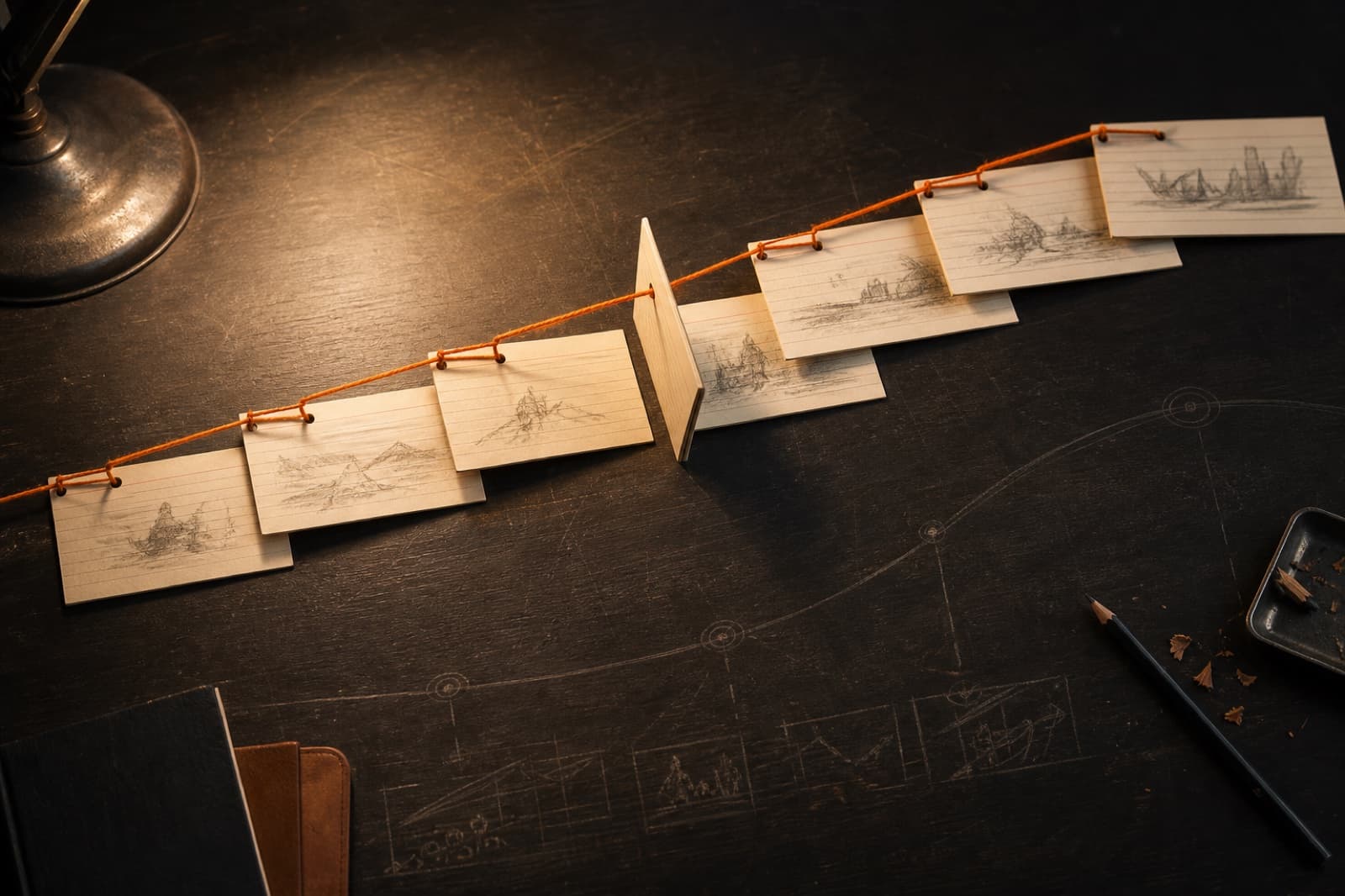
Try this with index cards, a notebook or the margin of your draft. The tool does not matter. What matters is seeing how one choice leads to the next.
- 1
Locate commitment
Find the choice that converts the problem from something happening nearby into the protagonist's active story.
- 2
Split the middle
Use a central reversal to divide early experimentation from late consequence.
- 3
Destroy the first plan
The end of act two should make the old method insufficient and demand a final, revealing approach.
- 4
Resolve then release
After the climax, give the audience only the aftermath needed to understand the new life.
04 / Trouble spots
If this feels familiar, take another look
Act one delays the story with biography.
Act two is one long samey pursuit.
Act three introduces a convenient solution.
The protagonist makes no meaningful commitment at an act boundary.
Don't treat this list as a scorecard. Every draft has a few of these. Pick the one causing the most trouble, find the earliest place it appears and work forward from there.
05 / Have a go
Try this on your script
Write one sentence for the situation at the end of each act. The sentences should describe three genuinely different stages of the same problem.
A couple of questions writers ask
What does each act of a screenplay need to accomplish?
Act one establishes a functioning world and forces commitment; act two tests the plan they chose until it fails or transforms; act three concentrates the remaining conflict into decisive action and consequence.
How can I practise three-act structure?
Write one sentence for the situation at the end of each act. The sentences should describe three genuinely different stages of the same problem.
Where to go next