
Deep dive · Structure & Plot
The Sequence Approach
A less intimidating way to handle the long middle of a feature by breaking it into smaller stretches with their own purpose.
01 / The idea
How can sequences make the middle of a screenplay easier to write?
A sequence gives a section of the film a short-term goal and endpoint. Instead of writing an abstract sixty-page second act, the writer builds several connected movements, each with its own question, escalation and turn.
Structure can sound like engineering homework. On the page, it's much more human: somebody tries something, it changes the situation, and now they have to deal with what they started.
02 / What to remember
Three things worth holding onto
Think of these as questions to ask when the middle sags or the ending feels borrowed. They are there to help you hear the story, not force it into a template.
Local goals create momentum
A temporary objective gives scenes direction while the larger goal remains distant.
Sequences need turns, not pauses
The ending of a sequence should change the plan or situation, not simply announce the next location.
Variety belongs inside cause and effect
Different arenas, relationships and tones can refresh the film as long as each sequence grows from the last consequence.
03 / On the page
Try it this way
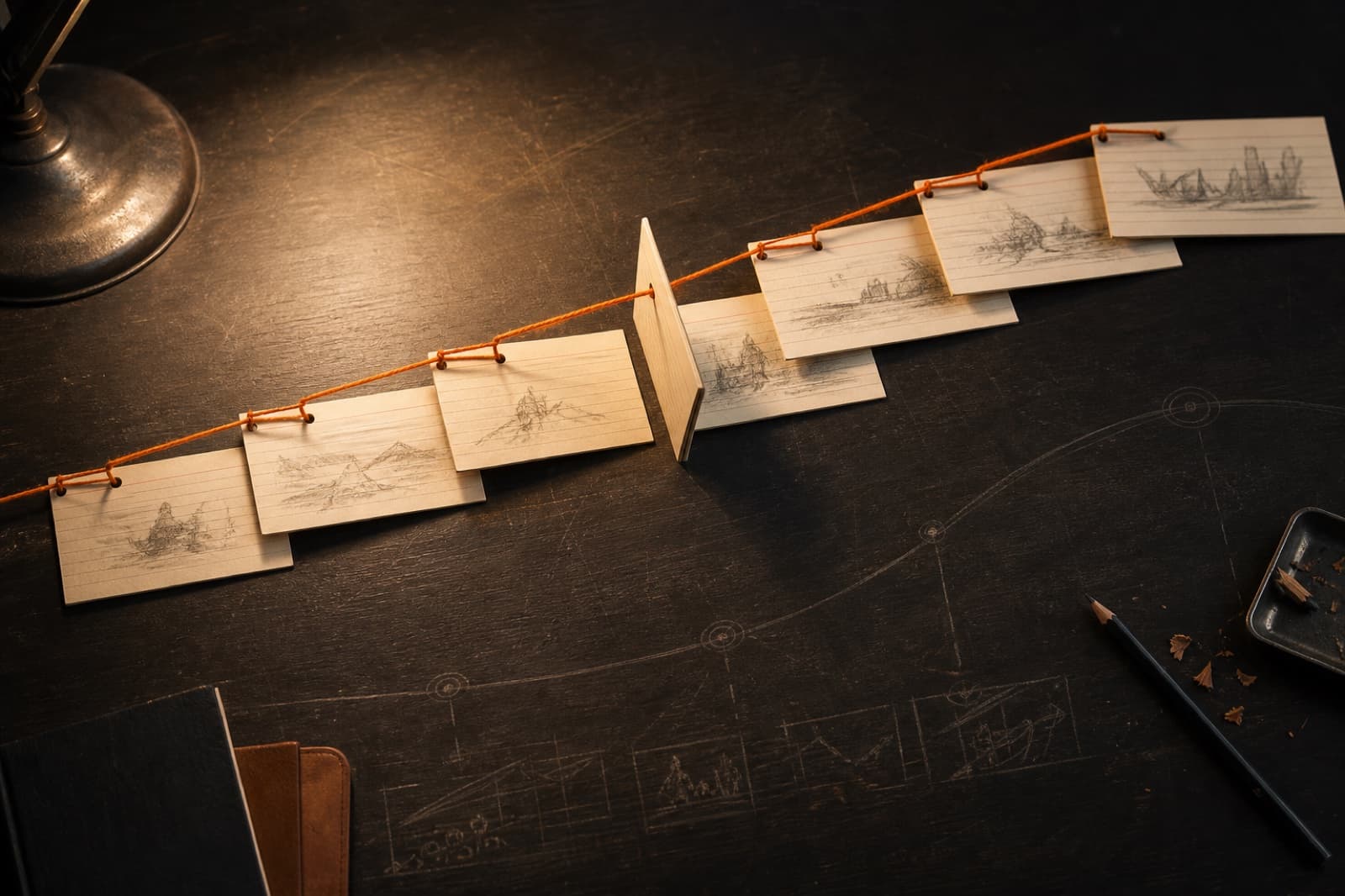
Try this with index cards, a notebook or the margin of your draft. The tool does not matter. What matters is seeing how one choice leads to the next.
- 1
Follow the plan the character is trying
Group scenes according to what the protagonist currently believes will solve the problem.
- 2
Give each movement a question
Ask a concrete question the sequence can answer, such as whether the team can recruit the final member.
- 3
End on something newly learned
Use victory, defeat, discovery or reversal to make the next movement necessary.
- 4
Make sure it costs more each time
Every sequence should leave less safety, trust, time or innocence than the previous one.
04 / Trouble spots
If this feels familiar, take another look
Sequences feel like television episodes that reset.
The short-term objective is unrelated to the main goal.
A montage replaces dramatic decisions.
Every sequence has the same rhythm and outcome.
Don't treat this list as a scorecard. Every draft has a few of these. Pick the one causing the most trouble, find the earliest place it appears and work forward from there.
05 / Have a go
Try this on your script
Divide your story into eight index-card columns. Give each column a verb, a local goal and a final change. Remove any column that leaves the story as it found it.
A couple of questions writers ask
How can sequences make the middle of a screenplay easier to write?
A sequence gives a section of the film a short-term goal and endpoint. Instead of writing an abstract sixty-page second act, the writer builds several connected movements, each with its own question, escalation and turn.
How can I practise the sequence approach?
Divide your story into eight index-card columns. Give each column a verb, a local goal and a final change. Remove any column that leaves the story as it found it.
Where to go next